This guide covers every step for Nigerian patients traveling to India for medical treatment — from gathering documents in Lagos or Abuja to landing in India.
What Is an Indian Medical Visa?
An Indian Medical Visa (MED) is a special visa category issued by the Government of India specifically for foreign nationals traveling to India for medical treatment. It is different from a tourist visa and cannot be used for treatment purposes.
Two visa types exist: the MED visa (issued to the patient) and the MED-X visa (Medical Attendant Visa, issued to accompanying family members). A maximum of 2 attendants may travel with a single patient.
Quick Reference Table
| Feature | Regular Medical Visa (In-Person Application) |
|---|---|
| Validity | Up to 1 year or treatment duration, whichever is less |
| Entry | Triple entry (default) |
| Processing Time | 3–5 working days after appointment |
| Fee (approx.) | USD 585 + USD 3 ICWF = USD 588 total |
| Embassy Visit Required | Yes — in-person at HCI Abuja or CGI Lagos |
| e-Visa Available | NO — Nigerian nationals are not eligible for e-Visa |
Eligibility
Nigerian citizens with a valid Nigerian passport are eligible to apply for an Indian Medical Visa if the purpose of travel is medical treatment at a recognized Indian hospital. Applicants must demonstrate a genuine medical need, hold an invitation/appointment letter from an Indian hospital, and carry a passport valid for at least six months beyond the intended date of arrival.
Important: As of 2026, there is no e-Visa facility available for Nigerian nationals. All visa applications must be submitted in person at the High Commission of India (HCI) in Abuja or the Consulate General of India (CGI) in Lagos.
Documents Required
Patient Documents
- Valid Nigerian passport (minimum 6 months validity from date of arrival, with at least 2 blank pages)
- Photocopy of the passport data page
- Two recent passport-sized photographs (50mm × 50mm / 2 inch × 2 inch, white or light background)
- Completed online visa application form (printed and signed — signature must match passport)
Medical Documents
- Referral letter from a recognized Nigerian hospital or registered medical practitioner, stating the medical condition and confirming the need for treatment abroad. The letter must be on official letterhead, signed and stamped, and sent from the hospital’s official email address to the Indian Mission
- All relevant investigation reports (blood tests, MRI, CT scan, X-ray, biopsy reports, etc.)
- Invitation/appointment letter from a recognized Indian hospital (on official letterhead, signed and stamped, including patient name, passport number, treatment recommendation, cost estimate, and appointment date — also emailed directly to the Indian Mission from the hospital’s official email)
- For transplant patients: compatibility report of donor and patient
- For follow-up treatment: previous medical papers and discharge summary from Indian hospital
Financial and Supporting Documents
- Certified bank statement for the last 3 months demonstrating sufficient funds to cover treatment and stay
- Yellow Fever Vaccination Certificate (mandatory — see section below)
- Oral Polio Vaccination (OPV) or Inactivated Polio Vaccine (IPV) certificate (mandatory — see section below)
- Return flight itinerary
For MED-X (Attendant) applicants: All of the above plus a copy of the patient’s visa application and proof of relationship to the patient.
Yellow Fever Certificate — MANDATORY
Nigeria is classified as a Yellow Fever endemic country. India requires all travelers arriving from Nigeria to present a valid Yellow Fever Vaccination Certificate (International Certificate of Vaccination or Prophylaxis — ICVP/Yellow Card). The vaccine must be administered at least 10 days before arrival in India to be valid. Travelers without a valid certificate will be quarantined for up to 6 days on arrival at the Indian airport. Get vaccinated at an authorized vaccination centre and carry the original Yellow Card.
Polio Vaccination Certificate — MANDATORY
All Nigerian nationals visiting India are required to carry proof of polio vaccination. You must submit a valid polio vaccination certificate with at least one dose of bivalent oral polio vaccine (bOPV) or inactivated polio vaccine (IPV) within the previous 12 months, administered not less than 4 weeks prior to arrival in India. The OPV/IPV certificate is valid for one year from the date of administering it. This requirement has been in effect since March 1, 2014.
Step-by-Step Application Process
- Step 1 — Get a medical opinion from a hospital in India. Share your reports to receive a treatment recommendation, cost estimate, and formal invitation letter. This letter is required before applying.
- Step 2 — Collect all required documents. Obtain the referral letter from your local Nigerian hospital, gather all medical investigation reports, ensure your passport is valid, and get your Yellow Fever and Polio vaccinations.
- Step 3 — Apply online at indianvisaonline.gov.in. Complete the online visa application form. Print the completed form and sign it in the designated boxes. Your signature must match the one in your passport.
- Step 4 — Book and attend your embassy appointment. Appear in person at the High Commission of India in Abuja or the Consulate General of India in Lagos with originals and photocopies of all documents. Pay the visa fee at the Sterling Bank Plc counter within the embassy premises (payment in Nigerian Naira only — US Dollars not accepted).
- Step 5 — Attend your interview. The consular officer may request additional documents or ask questions about your treatment plan.
- Step 6 — Receive your visa. Collect your stamped passport during the collection window. Check all visa details carefully before travel.
Visa Fee Structure (2026)
| Fee Component | Amount |
|---|---|
| Visa Fee (all durations) | USD 585 |
| ICWF (Indian Community Welfare Fund) | USD 3 |
| Total | USD 588 (approx.) |
Payment is accepted only at the Sterling Bank Plc extension counter within the premises of the High Commission of India in Abuja or the Consulate General of India in Lagos. Payment in US Dollars is not accepted — fees must be paid in equivalent Nigerian Naira. All visa fees are non-refundable and subject to change. Verify current amounts directly with the Indian Mission before submitting.
Processing Time
Standard processing time for a Regular Medical Visa is 3–5 working days after your in-person appointment. Total realistic timeline from first contacting an Indian hospital to departing Nigeria: 7–14 business days, assuming all documents are in order. Track visa status at indianvisaonline.gov.in.
Indian Missions in Nigeria — Contact Details
| Detail | High Commission of India, Abuja | Consulate General of India, Lagos |
|---|---|---|
| Address | 364, Cadastral Zone, Central Business District (CBD), Off Constitution Avenue, FCT, Abuja | 8A, Walter Carrington Crescent, Victoria Island, Lagos |
| Phone | +234-7080622800 / 801 / 802 / 803 / 804 | +234-8128308758 |
| cons.abuja@mea.gov.in / cons1.abuja@mea.gov.in | visa.lagos@mea.gov.in / cons.lagos@mea.gov.in | |
| Visa submission hours | 10:00 AM – 12:00 PM (Monday–Friday) | 10:00 AM – 12:00 PM (Monday–Friday) |
| Passport/visa collection | 4:00 PM – 5:00 PM (Monday–Friday) | 4:00 PM – 5:00 PM (Monday–Friday) |
| Website | hciabuja.gov.in | cgilagos.gov.in |
Extending Your Medical Visa While in India
If your treatment takes longer than the visa validity allows, you can extend your Medical Visa while remaining in India. Submit extension requests to the Foreigners Regional Registration Office (FRRO) in the state where treatment is being received. Extensions are granted on medical grounds with a letter from your treating hospital. If your stay exceeds 180 days, you must register with the FRRO within 14 days of arrival in India.
Common Mistakes to Avoid
- Forgetting the Yellow Fever vaccination — must be administered at least 10 days before travel; failure results in up to 6 days quarantine on arrival in India
- Forgetting the Polio vaccination (OPV/IPV) — must be administered at least 4 weeks before travel and within the last 12 months
- Not providing the local Nigerian hospital’s referral letter — this is non-negotiable and must be sent from the hospital’s official email to the Indian Mission
- Submitting a hospital invitation letter that was not emailed to the Indian Mission directly from the Indian hospital’s official email address
- Name mismatches between the passport and hospital documents
- Late planning — begin the process at least 2–3 weeks before your intended travel date
- Applying without a hospital letter that includes all required details: patient name, passport number, diagnosis, treatment plan, cost estimate, and appointment date
- Paying the visa fee in US Dollars — only Nigerian Naira is accepted at the Sterling Bank counter within the embassy premises
Frequently Asked Questions
1. Are the Yellow Fever and Polio certificates really required?
Yes — both are absolutely mandatory. Nigeria is classified as both a Yellow Fever endemic country and a polio-affected country. India requires a valid Yellow Fever Vaccination Certificate and a valid Polio Vaccination Certificate (OPV or IPV) from all Nigerian travelers. If you arrive at an Indian airport without a valid Yellow Fever certificate, you will be placed in quarantine for up to 6 days. The Yellow Fever vaccination must be administered at least 10 days before travel. The Polio vaccination must be administered at least 4 weeks before travel and within the last 12 months. Get vaccinated at authorized centres in Nigeria and carry the original certificates.
2. Is a referral letter from a Nigerian hospital mandatory?
Yes. A referral letter from a recognized Nigerian hospital is a non-negotiable requirement for the Indian Medical Visa. It must state your medical condition, confirm why treatment is required abroad, and be on official letterhead with the hospital’s stamp and signature. The letter must be sent from the hospital’s official email address to the Indian Mission. Applications submitted without this letter are routinely rejected. There is no workaround — even if you already have a detailed hospital letter from an Indian hospital, the local referral is still required separately.
3. Can I apply for an e-Medical Visa online?
No. As of 2026, there is no e-Visa facility available for Nigerian nationals. All visa applications — including Medical Visas — must be submitted in person at the High Commission of India in Abuja or the Consulate General of India in Lagos, along with physical copies of all required documents. The online form must be completed at indianvisaonline.gov.in, printed, signed, and submitted in person at the embassy.
4. How long does it take to get an Indian Medical Visa from Nigeria?
For the Regular Medical Visa through the Indian Mission: processing takes 3–5 working days after attending your in-person appointment. The total realistic timeline from first contacting an Indian hospital to departing Nigeria is 7–14 business days, assuming all documents are in order. Start the process early — rushing near your travel date is the most common cause of delays and rejections.
5. How many family members can accompany a patient on a Medical Attendant Visa (MED-X)?
Up to 2 family members or caregivers may accompany the patient on a Medical Attendant Visa (MED-X). Each attendant must apply for the MED-X visa simultaneously with the patient’s application. Attendants must carry the same core documents as the patient, plus proof of their relationship to the patient (e.g., birth certificate, marriage certificate). The MED-X visa follows the same validity period and conditions as the patient’s MED visa.
6. Can I extend my Indian Medical Visa if treatment takes longer than expected?
Yes. If your treatment requires more time than your visa validity permits, you can apply for a visa extension without leaving India. Extension applications are submitted to the Foreigners Regional Registration Office (FRRO) in the city where your treatment is taking place. You must provide a letter from your treating hospital confirming the ongoing treatment plan and the additional time required. Extensions are granted on medical grounds and are subject to approval by the FRRO. If your stay exceeds 180 days, you must register with the FRRO within 14 days of arrival in India. It is advisable to apply for an extension before your current visa expires — do not overstay.
7. What happens if my visa application is rejected?
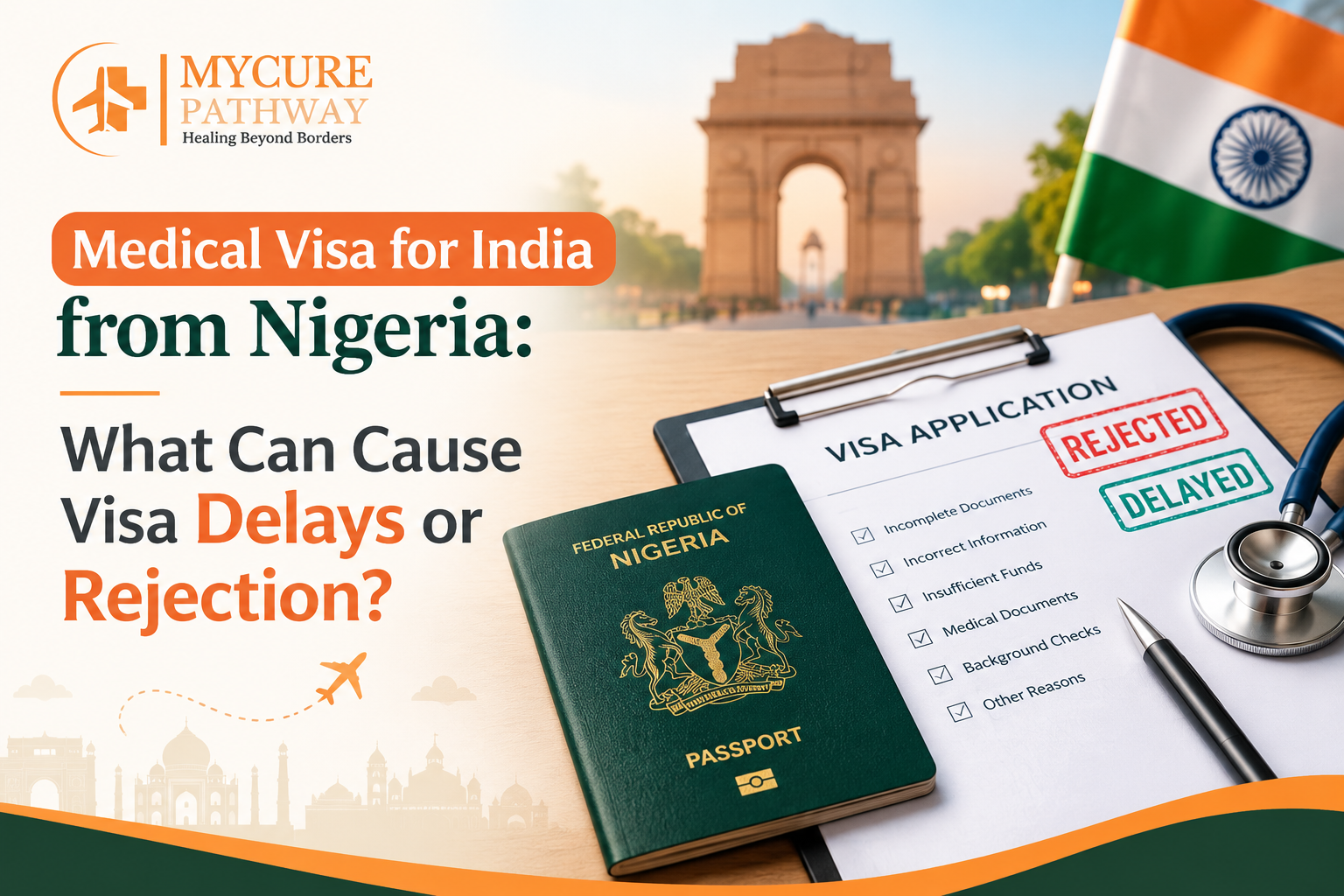
If your Indian Medical Visa application is rejected, the most common reasons are: missing or incomplete local Nigerian hospital’s referral letter, hospital invitation letter not emailed to the Indian Mission from the hospital’s official email address, name mismatches between passport and hospital documents, or insufficient financial documentation. You can re-apply after addressing the reason for rejection — there is no mandatory waiting period. Carefully review all document requirements before resubmitting. If the rejection reason is not communicated clearly, contact the Indian Mission directly for clarification.
Disclaimer: We are not affiliated with the Government of India or any official Embassy, High Commission, or Bureau of Immigration. We do not issue visas or charge government processing fees. All visa requirements and processing times are subject to change by state authorities.