A brain tumor diagnosis can raise many questions, especially when a patient wants to understand whether treatment is possible without an operation. Depending on the tumor’s type, size, location, growth rate, and effect on surrounding brain tissue, doctors may recommend treatments that do not require conventional open surgery. These approaches can include radiation therapy, chemotherapy, targeted medicines, and careful monitoring in selected cases.
Brain tumor treatment without surgery may be considered when a tumor is difficult to access surgically, when surgery carries significant risks, or when a particular tumor responds well to medication or radiation. Some patients may also receive non-surgical treatment after a biopsy or an earlier operation. The most appropriate approach depends on an individual medical assessment rather than a single treatment rule.
India offers a range of specialist services for brain tumor diagnosis and treatment, including neuro-oncology, radiation oncology, neurosurgery, advanced imaging, and molecular testing. Patients exploring brain tumor treatment in India should seek a multidisciplinary opinion to understand the potential benefits, limitations, costs, and risks of each option.
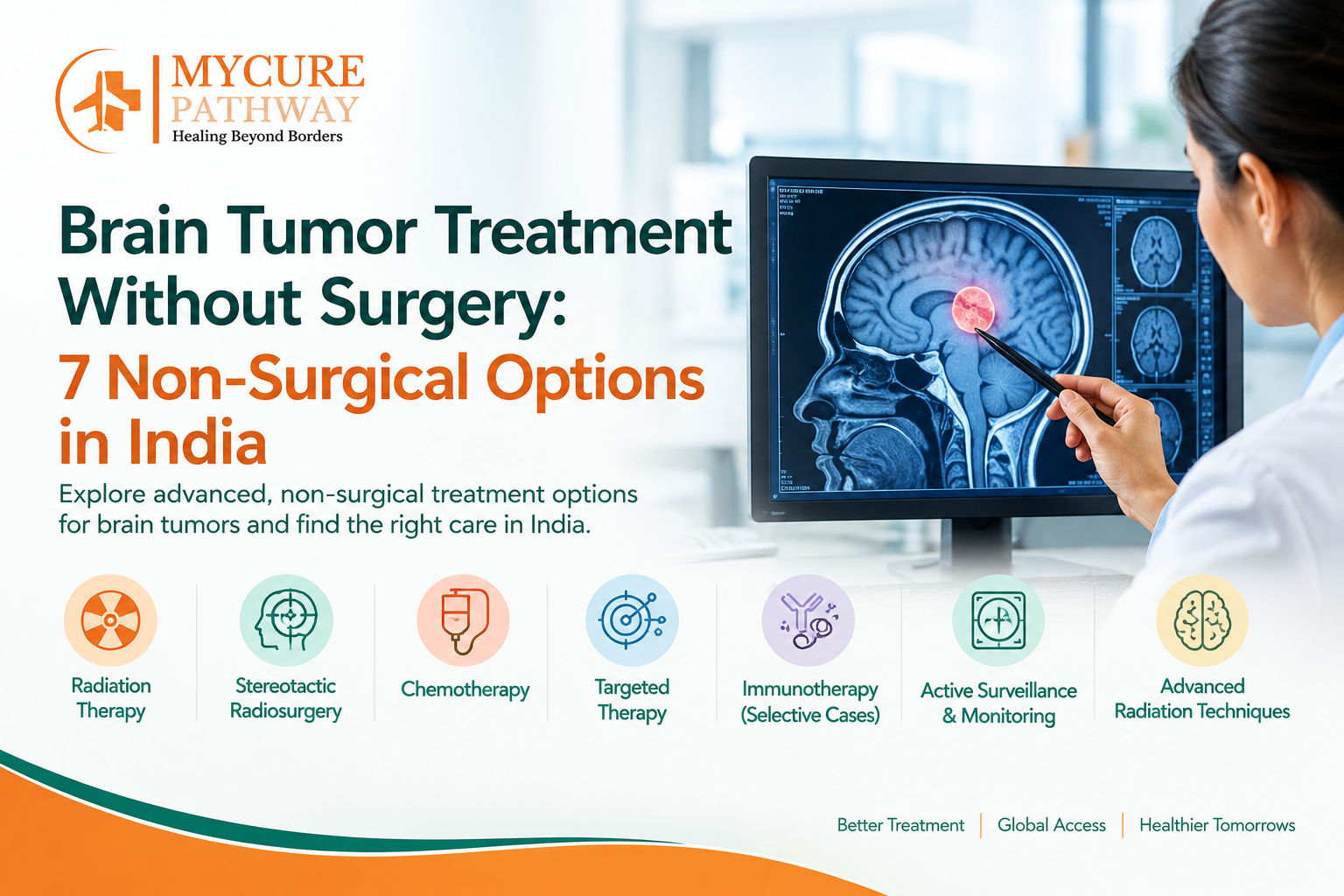
This guide explains seven non-surgical brain tumor treatment options, how they work, and what patients should discuss with their treating team.
Can a Brain Tumor Be Treated Without Surgery?
Yes, some brain tumors can be treated without removing them through conventional surgery. However, non-surgical treatment is not suitable for every tumor, and it does not always mean that a patient will never need an operation.
The recommended treatment depends on several factors:
- Tumor type: Some tumors respond well to radiation or medicines, while others may require surgical removal for diagnosis or control.
- Tumor location: A tumor close to critical areas of the brain may be difficult to operate on safely.
- Tumor size and growth: Small, slow-growing tumors may sometimes be monitored, while larger or rapidly growing tumors may need prompt treatment.
- Symptoms: Seizures, weakness, vision changes, headaches, or signs of increased pressure in the brain can influence treatment decisions.
- Tumor grade and molecular characteristics: Pathology and molecular test results can help doctors identify the most suitable therapy.
- Overall health: Age, other medical conditions, and the patient’s ability to tolerate treatment also matter.
In some cases, a biopsy is still needed to confirm the diagnosis even when treatment does not involve removing the entire tumor. A biopsy is a procedure, so the term non-surgical treatment should not automatically be interpreted as meaning that no procedure will be required.
1. Stereotactic Radiosurgery for Brain Tumors
Stereotactic radiosurgery is a highly precise form of radiation treatment that delivers concentrated radiation to a defined target in the brain. Despite the word surgery, it usually does not involve an incision or the physical removal of a tumor.
It may be recommended for selected small or well-defined tumors, depending on their type, location, size, and proximity to sensitive brain structures.
How Does Stereotactic Radiosurgery Work?
The treatment team uses detailed imaging, such as MRI and sometimes CT scans, to identify the target. A specialised system then directs radiation beams toward the tumor while limiting exposure to surrounding tissue as much as possible.
Depending on the treatment system and clinical plan, treatment may be delivered in one session or divided into several sessions.
Which Brain Tumors May Be Suitable?
Stereotactic radiosurgery may be used for selected cases of:
- Brain metastases, which are tumors that have spread to the brain from another part of the body.
- Certain meningiomas.
- Vestibular schwannomas, also called acoustic neuromas.
- Some other small, well-defined intracranial lesions.
It is not appropriate for every brain tumor. Larger tumors, tumors causing significant pressure, and lesions close to sensitive structures may require a different radiation schedule or another treatment approach.
Potential Benefits and Limitations
The main advantage is that treatment can target a small area without an open operation. However, radiation effects develop over time, and the tumor may not shrink immediately. Swelling, temporary neurological symptoms, and radiation-related tissue changes are possible complications.
2. Fractionated Brain Tumor Radiation Therapy
Radiation therapy uses high-energy radiation to damage tumor cells and prevent them from growing or dividing. It is an important component of treatment for several primary brain tumors and brain metastases.
Unlike stereotactic radiosurgery, conventional or fractionated brain tumor radiation therapy generally divides the prescribed dose into multiple smaller treatments over a planned period.
How Is Radiation Therapy Delivered?
The patient usually undergoes a planning process involving imaging and precise positioning. The radiation oncology team designs a treatment plan that aims to deliver the required dose to the target while protecting healthy brain tissue and other critical structures.
The number of sessions depends on the tumor diagnosis, treatment goals, location, and radiation technique.
When Is It Recommended?
Radiation therapy may be used for selected:
- High-grade gliomas, including glioblastoma.
- Certain low-grade or intermediate-grade brain tumors.
- Meningiomas that require treatment but are not suitable for surgery.
- Brain metastases.
- Tumors that remain after surgery or have returned following earlier treatment.
For some tumors, radiation is the main treatment. In other situations, it is combined with chemotherapy or used after an operation.
Side Effects to Discuss
Possible side effects include fatigue, scalp irritation, hair loss in the treated area, nausea in some patients, and temporary swelling. Longer-term effects depend on the dose, the area treated, the patient’s age, and other clinical factors.
The medical team will explain the expected benefits and risks before treatment begins.
3. Chemotherapy for Brain Tumors
Brain tumor chemotherapy uses medicines to destroy cancer cells, slow their growth, or prevent them from multiplying. It may be recommended for certain malignant brain tumors, particularly when the disease is likely to respond to specific medicines.
Chemotherapy can be administered orally or intravenously, depending on the drug and treatment plan. Some medicines can reach brain tumors more effectively than others, so drug selection is important.
Which Brain Tumors May Require Chemotherapy?
Chemotherapy may form part of treatment for conditions such as:
- Glioblastoma and selected other high-grade gliomas.
- Certain primary central nervous system lymphomas.
- Some pediatric brain tumors.
- Other tumors that are known to respond to particular chemotherapy regimens.
Temozolomide is one medicine commonly used in the treatment of certain gliomas, including glioblastoma. It may be administered alongside radiation therapy and continued afterward, depending on the diagnosis and the treatment protocol.
For primary central nervous system lymphoma, treatment often involves specialised chemotherapy regimens, which may include high-dose methotrexate. The exact medicines and supportive care depend on the patient’s condition.
What Should Patients Expect?
Before chemotherapy begins, doctors may check blood counts, kidney function, liver function, and other parameters relevant to the planned medicines. These assessments help identify risks and guide dose adjustments.
Possible side effects include fatigue, nausea, reduced blood cell counts, increased infection risk, and other drug-specific effects. Patients should report new symptoms promptly and follow the prescribed monitoring schedule.
Chemotherapy is not effective for every brain tumor. A neuro-oncology team determines whether the expected benefit justifies the potential risks.
4. Targeted Therapy for Brain Tumors
Targeted therapy uses medicines that act on particular molecular changes or biological pathways involved in tumor growth. Unlike conventional chemotherapy, which affects dividing cells more broadly, targeted treatments are designed to interfere with specific features of a tumor.
However, targeted therapy is only useful when the tumor has the relevant biological characteristics and the medicine is appropriate for that diagnosis.
Why Molecular Testing Matters
A tumor sample may undergo molecular analysis to identify genetic alterations, protein markers, or other features that can influence treatment decisions. Depending on the tumor, testing may examine markers such as IDH mutations, BRAF alterations, or other clinically relevant changes.
These findings can help doctors classify the tumor more accurately and determine whether a targeted treatment is appropriate.
When Can Targeted Therapy Be Used?
Targeted medicines may be considered for selected brain tumors with specific molecular features. For example, certain tumors with BRAF alterations may be candidates for BRAF- and MEK-targeted combinations. Other therapies may be considered according to the tumor type, approved indications, available evidence, and local treatment guidelines.
Not every patient will have an actionable target, and the presence of a mutation does not automatically mean that a particular medicine will be suitable.
Benefits and Limitations
Targeted treatment may offer an option when conventional approaches are unsuitable or when a tumor has specific molecular characteristics. Nevertheless, side effects, drug interactions, resistance, and access to appropriate medicines must be considered.
Patients should ask their treating specialist whether molecular testing could change their treatment plan.
5. Immunotherapy for Selected Brain Tumors
Immunotherapy helps the body’s immune system recognise or respond to cancer. It has transformed treatment for some cancers, but its role in brain tumors varies considerably by diagnosis.
Brain tumors have complex interactions with the immune system, and many do not respond reliably to currently available immunotherapies. For this reason, immunotherapy is not a universal treatment for brain cancer.
How Does Immunotherapy Work?
Different immunotherapies work in different ways. Some medicines block immune checkpoints, which can help immune cells mount an attack against cancer under suitable circumstances. Other approaches aim to stimulate or redirect immune responses.
In selected circumstances, immune-based treatments may be considered for particular tumor types, molecular subgroups, or clinical trial settings.
Who May Be Eligible?
Eligibility depends on the exact diagnosis, molecular findings, previous treatments, general health, and the evidence supporting the proposed medicine.
Patients should be cautious of claims that immunotherapy is effective for every brain tumor or can guarantee a cure. The treating oncologist should explain the evidence for the specific diagnosis, whether the treatment is approved for that use, and whether a clinical trial is an option.
Possible side effects vary by medicine and may include inflammation affecting healthy organs. Close medical monitoring is important.
6. Targeted Radiation Techniques and Advanced Treatment Planning
Modern radiation oncology uses different technologies and planning methods to deliver radiation accurately. These are not all separate treatments; rather, they are approaches that may help the team select and deliver an appropriate radiation plan.
Depending on the case, options may include intensity-modulated radiation therapy (IMRT), image-guided radiation therapy (IGRT), and proton therapy at centres where it is available and clinically appropriate.
Intensity-Modulated Radiation Therapy
IMRT adjusts the intensity of radiation beams to shape the dose around a tumor. This can help limit radiation exposure to nearby structures, depending on the tumor’s location and treatment plan.
Image-Guided Radiation Therapy
IGRT uses imaging during treatment planning or delivery to improve positioning accuracy. It can be useful when precise alignment is particularly important.
Proton Therapy
Proton therapy uses charged particles that can deposit much of their energy at a planned depth. In selected cases, this may reduce radiation exposure to some surrounding tissues. Its suitability depends on the diagnosis, tumor location, available expertise, and whether the expected benefit justifies the cost and travel.
Not every patient needs advanced radiation technology, and a newer technique is not automatically better for every tumor. The radiation oncologist should explain why a particular method is recommended.
7. Active Surveillance and Regular Monitoring
Not every brain tumor needs immediate treatment. For certain slow-growing tumors that are not causing significant symptoms, doctors may recommend active surveillance, also called watchful monitoring.
This is an organised medical strategy, not an absence of care. It involves scheduled consultations, neurological assessment, and repeat imaging to identify changes that may require treatment.
Which Tumors May Be Monitored?
Active surveillance may be appropriate for selected patients with:
- Small, asymptomatic meningiomas without concerning features.
- Certain slow-growing tumors identified incidentally.
- Some benign or low-grade lesions where immediate treatment risks outweigh the expected benefits.
The decision depends on tumor characteristics, growth patterns, age, symptoms, and the patient’s overall health. Some tumors that initially appear suitable for monitoring may need treatment if they grow or begin causing problems.
How Is Monitoring Carried Out?
Doctors may use MRI scans at intervals determined by the diagnosis and clinical circumstances. They also review symptoms and neurological function.
Patients should attend all scheduled appointments and seek medical advice if new symptoms develop. Monitoring intervals are individualised; there is no single scan schedule suitable for every tumor.
How Do Doctors Choose the Right Non-Surgical Brain Tumor Treatment?
Selecting among brain tumor treatment options requires a careful assessment of the diagnosis and the patient’s circumstances. A treatment that works well for one tumor may be ineffective or inappropriate for another.
The medical team may consider the following factors:
1. Accurate diagnosis: MRI can help identify the location and characteristics of a tumor, but imaging alone may not establish its exact type. A biopsy or tissue-based diagnosis may be needed.
2. Tumor grade and molecular profile: Pathology and molecular tests can provide information about tumor behaviour and potential treatment responses.
3. Symptoms and pressure effects: Tumors causing significant swelling, obstruction of cerebrospinal fluid flow, or neurological deterioration may require urgent intervention. Non-surgical therapy may not act quickly enough in these situations.
4. Treatment goals: The aim may be to control tumor growth, reduce symptoms, prolong survival, or maintain quality of life. The goal varies according to the tumor type and stage.
5. Previous treatment: Earlier surgery, radiation, or medicines influence which options remain suitable and what risks may arise from further treatment.
6. Multidisciplinary review: A team involving neuro-oncology, radiation oncology, neurosurgery, neuroradiology, and pathology can help compare the available approaches.
Patients should ask whether treatment is intended to cure the tumor, control it over time, or relieve symptoms. Understanding the goal makes it easier to compare the expected benefits, limitations, and risks.
Brain Tumor Treatment in India: What Should International Patients Know?
India has hospitals and specialist centres offering diagnostic imaging, neurosurgical assessment, radiation oncology, chemotherapy, and selected advanced cancer treatments. The availability of particular techniques, medicines, and clinical trials varies between hospitals.
Patients considering brain tumor treatment in India can take several steps to prepare.
Organise Medical Records
Collect previous MRI and CT scans, radiology reports, biopsy and pathology results, molecular testing reports, and details of medicines or treatments already received. Where possible, ask the hospital whether it needs the original imaging files rather than written reports alone.
Request a Specialist Review
A neuro-oncology team can review the available records and advise whether further testing is needed. If surgery is not recommended or the patient wishes to explore alternatives, ask the specialist to explain the reasons and discuss the suitability of non-surgical treatment.
Understand the Treatment Plan and Costs
Costs vary according to the diagnosis, hospital, treatment technique, medicines, number of sessions, required tests, and follow-up care. Request an itemised estimate and clarify what is included, such as specialist consultations, planning scans, medicines, hospital stays, and follow-up imaging.
For international patients, travel and accommodation may also need to be considered. Some treatments require repeated hospital visits over several weeks, so the likely duration of stay should be discussed with the treating team before travel.
Plan Follow-Up Care
Brain tumor treatment often requires ongoing MRI scans, clinical reviews, and monitoring for side effects. Patients travelling to India should discuss how follow-up will be coordinated after returning home and which records should be shared with their local doctor.
MyCurePathway can assist international patients with medical record coordination, specialist consultation arrangements, and treatment-related travel planning in India. The treating hospital and its clinical team remain responsible for diagnosis, treatment recommendations, and medical decisions.
Frequently Asked Questions
1. Can a brain tumor be cured without surgery?
Some brain tumors can be controlled or, in selected cases, treated with curative intent without conventional tumor-removal surgery. The outcome depends on the tumor type, grade, location, and response to radiation or medicines. Other tumors require surgery or a combination of approaches.
2. What is the best non-surgical brain tumor treatment?
There is no single best treatment for every patient. Stereotactic radiosurgery, fractionated radiation, chemotherapy, targeted therapy, immunotherapy in selected cases, and active surveillance may each be appropriate in different circumstances. A specialist assessment is necessary to identify the right approach.
3. Is radiation therapy effective for brain tumors?
Radiation therapy is an established treatment for many brain tumors. Its effectiveness depends on the tumor’s biology, size, location, radiation technique, and whether other treatments are used alongside it. Some tumors respond well, while others may be less sensitive to radiation.
4. Is chemotherapy always required for brain cancer?
No. Chemotherapy is recommended for certain brain tumors but is not necessary for all of them. Some patients may receive radiation, targeted treatment, surgery, or monitoring depending on their diagnosis and individual treatment plan.
5. How much does brain tumor treatment without surgery cost in India?
The cost varies according to the treatment method, tumor type, hospital, medicines, number of radiation sessions, diagnostic tests, and follow-up requirements. Patients should request a personalised estimate from the treating hospital rather than rely on a fixed price.
6. Can patients receive brain tumor treatment in India without travelling for an initial opinion?
Some hospitals may offer a preliminary remote review based on medical records and imaging. However, an online opinion may not replace an in-person examination, additional testing, or a formal diagnosis. Patients should confirm the hospital’s requirements before making travel arrangements.
Conclusion
Brain tumor treatment without surgery may be possible for selected patients through radiation therapy, stereotactic radiosurgery, chemotherapy, targeted medicines, immunotherapy in specific circumstances, and active surveillance. The right approach depends on the tumor’s diagnosis, biological characteristics, location, symptoms, and the patient’s overall health.
Patients should not assume that every brain tumor can be treated without an operation or that avoiding surgery is always the safest choice. In some situations, surgery or biopsy may be necessary to establish the diagnosis, relieve pressure, or improve treatment outcomes.
For those exploring brain tumor treatment in India, a specialist review can help clarify the available options, expected benefits, possible side effects, and likely costs. MyCure Pathway can support international patients in coordinating medical consultations and treatment planning so they can discuss their individual needs with the appropriate medical team.